Rooftop units (RTU) · Toronto & GTA

Rooftop HVAC for buildings
that trade every day

Packaged rooftop units heat, cool and ventilate most of the small commercial buildings in the GTA. We service, replace and change over RTUs on shops, offices, clinics and restaurants — scheduled so the room below stays open.

Service, replacement & changeovers
Work scheduled around trading hours
Shops, offices, clinics & restaurants
Crane and roof access coordinated
At a glance
EquipmentPackaged rooftop units
Typical range3 to 6 ton RTUs
ServicesService & replacement
Service areaToronto & GTA
1,000+
Clients served
TSSA
Certified team
7 days
A week support
GTA-wide
Service coverage
20+ yrs
Climate experience
What it is

What is a rooftop HVAC unit?

A rooftop unit — an RTU — is a single packaged machine that sits on the roof and does the whole job: heating, cooling, and bringing in fresh air. Everything is in one cabinet, connected to the space below through a pair of ducts and a curb.

That packaging is the reason RTUs are everywhere on small commercial buildings. There is no plant room taking up lettable floor space, no equipment for customers to see or hear at close range, and servicing happens on the roof rather than in the middle of a trading space.

The trade-off is that everything depends on one machine sitting outside in a Toronto winter. Sizing, curb condition, and whether it is actually delivering the fresh air the building needs matter more than the badge on the cabinet.

What matters most for commercial rooftop units in the GTA
Right sizing, licensed gas/refrigeration work, and commissioning beat the cheapest sticker price. We verify airflow, safety devices, condensate paths, and controls so your system does not fail the first extreme week of the season. Ask us about dual-fuel, zoning, and rebate-eligible models during your quote.
What we check on an RTU assessment
  • Actual load against the unit currently fitted — over- and undersizing are both common
  • Curb condition, flashing and whether a replacement will fit the existing opening
  • Economiser and outside-air damper operation — often found seized
  • Filters, coils and drain condition
  • Gas heat section, ignition and venting
  • Controls, thermostat placement and whether zoning matches how the space is used
  • Roof access and whether a crane or hoist will be required
  • Age and parts availability against the cost of continuing to repair
How it works

One cabinet, three jobs

Heating, cooling and ventilation handled in a single packaged unit on the roof.

Return air drawn up
From the space below
Outside air mixed in
Via the economiser damper
Filtered
Before it reaches the coils
Heated or cooled
Gas section or DX coil
Supplied back down
Through the curb and ducts
Commercial applications

Buildings that run on rooftop units

Different occupancies put very different demands on the same style of equipment.

Retail & storefronts
Street doors opening constantly and a sales floor that has to stay comfortable through it. Entrance conditions and unit sizing matter more here than headline capacity.
Offices & professional suites
Predictable occupancy, but tight tolerance for noise and drafts. Zoning and thermostat placement usually decide whether an office is comfortable, not the unit itself.
Clinics & medical suites
Ventilation and filtration expectations are higher, and downtime is disruptive to booked appointments. Planned replacement beats emergency replacement.
Restaurants & food service
Kitchen extraction removes a large volume of air that must be replaced. RTUs here work alongside make-up air, or the dining room ends up in permanent negative pressure.
Warehouses & light industrial
Often RTUs for the office and front-of-house, with radiant heating over the working floor — two systems, each doing what it is good at.
Multi-tenant & mixed use
Several units of different ages and brands on one roof. Planned maintenance across the set beats reacting to whichever one fails first.
What we do

Rooftop HVAC services

Service, repair, replacement and changeovers on commercial roofs across the GTA.
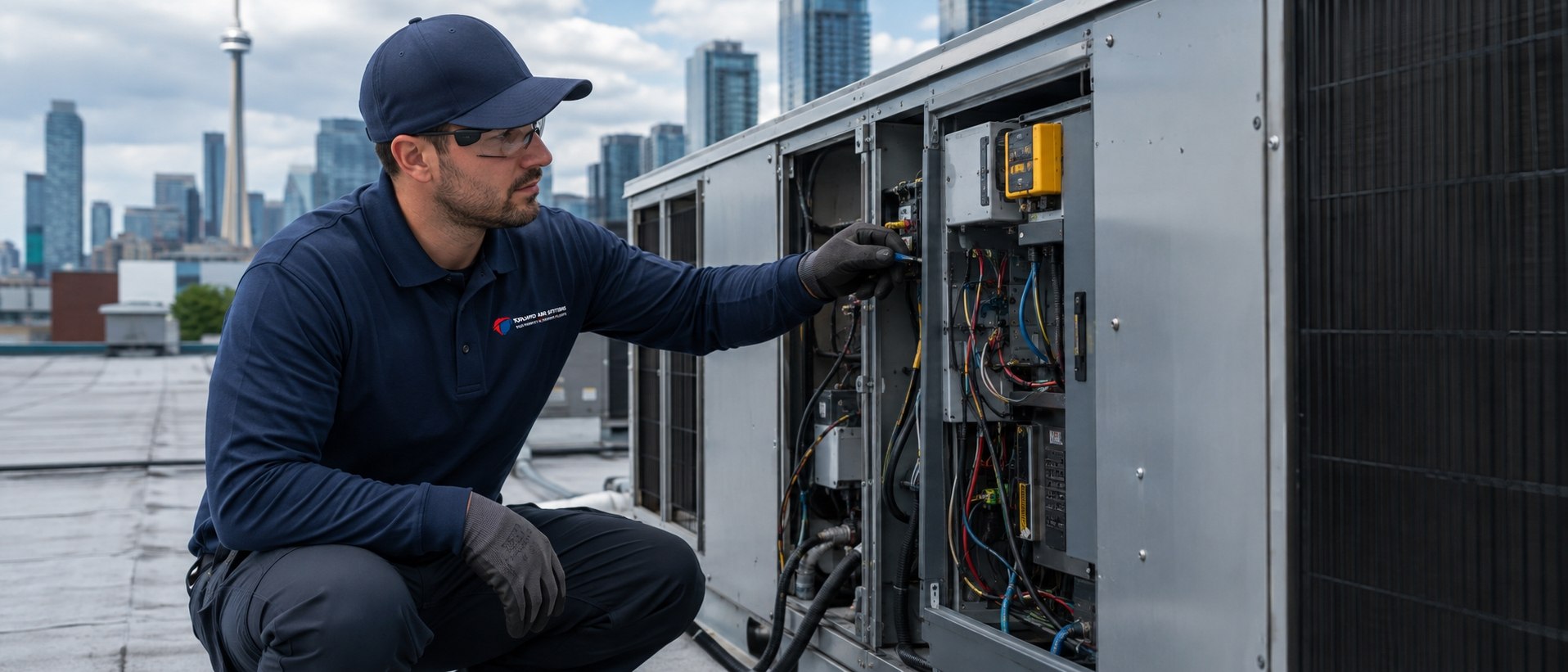
RTU service & planned maintenance
Scheduled servicing covering filters, coils, drains, dampers, belts, gas heat and controls — with documented visits for property managers.
Diagnostics & repair
Fault finding on heating, cooling, ventilation and controls, with an honest answer on whether continued repair is worth it against the age of the unit.
Replacement & changeovers
Like-for-like replacement and changeovers, including curb adaptation where the new unit does not match the existing opening.
Sizing & load assessment
Right-sizing against the actual load rather than replacing like-for-like by default — oversized units short-cycle and control humidity poorly.
Make-up air & ventilation
Tempered make-up air for commercial kitchens, so extraction is not pulling untreated cold air in through the front door.
Crane & access coordination
Lift planning, roof access and scheduling arranged around your trading hours and the building's other tenants.

Before the next failure

Most rooftop emergencies were visible at the last service

Seized economiser dampers, blocked drains and tired contactors are all found on a planned visit and all cause call-outs when they are not.

Book a rooftop assessment
Right-sized
Beats over-specified
An oversized rooftop unit short-cycles, controls humidity badly and wears itself out faster — while costing more to buy. A seized economiser damper quietly runs a building on mechanical cooling it does not need. Most of the efficiency available on an RTU comes from correct sizing, working dampers and clean coils, long before it comes from the specification sheet.
Why Toronto Air Systems

Why GTA property managers call us

Local crews, licensed workmanship, and recommendations built around how Toronto buildings actually heat and cool — not generic scripts.

We schedule around your trading hours
Replacements and changeovers planned for closed periods where the building allows, with the lift and access booked to match.
Sized against the load, not the old badge
Replacing a wrongly sized unit with another of the same size just repeats the problem. We assess the actual load before quoting a replacement.
A straight repair-or-replace answer
With both numbers. On an ageing unit with poor parts availability, we will say when further repair is not the sensible spend.
Documented planned maintenance
Scheduled visits with written reports — the arrangement multi-site operators and property managers need for their own records.
How it works

How rooftop work runs

From first call to commissioned equipment, you always know the next step, the timeline, and what is included.

Roof assessment
We inspect the unit, the curb and the access, and establish the actual load the space needs.
Options & written quote
Repair versus replacement with both sets of numbers, including curb adaptation and lift costs where relevant.
Access & lift planning
Crane or hoist, roof protection and timing agreed with you and, where needed, the building.
Installation or repair
Work carried out by licensed technicians, scheduled to keep the space below trading.
Commissioning & handover
Controls set, dampers proven, and a maintenance schedule put in place.
Brands we work with

Rooftop unit brands we service

We service and replace across the major commercial rooftop brands rather than pushing a single manufacturer.


Read first

Rooftop unit guides

Three articles covering sizing and replacement, written for the small-commercial buildings that make up most GTA rooftop work.

A complete guide to 3, 4, 5 and 6 ton rooftop units
What the tonnage actually means, and how the common small-commercial sizes compare in practice.
Read guide →
Which rooftop unit size is right for your space?
Sizing for a store, office, clinic or restaurant — and why matching the old unit is not a sizing method.
Read guide →
Commercial rooftop unit replacement: costs and sizing
What drives the cost of an RTU replacement in Toronto, and where the money actually goes.
Read guide →

View all News & Articles

Where we work

Rooftop HVAC across the GTA

Rooftop unit service, repair and replacement throughout the Greater Toronto Area.

Toronto
All neighbourhoods & districts
North York
Our home base
Mississauga
West GTA residential & commercial
Brampton
Full HVAC coverage
Vaughan
Including Woodbridge & Concord
Markham
East GTA homes & businesses
Richmond Hill
Residential & mixed-use
Scarborough
East Toronto
Etobicoke
West Toronto
Oakville
Halton Region
Pickering & Ajax
Durham Region
Whitby & Oshawa
East GTA
FAQ

Rooftop HVAC FAQ — Toronto & GTA

A single packaged machine on the roof that heats, cools and ventilates the space below, connected through ductwork and a curb. It keeps mechanical equipment out of lettable floor space and puts servicing on the roof rather than in a trading area.
It varies widely with maintenance, exposure and how hard the unit has been run. What usually decides replacement is not age alone but parts availability, the frequency of failures, and whether the unit was correctly sized in the first place.
We will give you both numbers. Repair usually makes sense on a well-sized unit with parts still available. Replacement moves ahead when failures are repeating, parts are scarce, or the existing unit was the wrong size for the space to begin with.
In most cases, yes. Changeovers are scheduled for closed periods or overnight where the building and the crane access allow. It is planned at quoting stage rather than improvised on the day.
Usually for a full replacement, though it depends on the size of the unit and the roof access available. Lift requirements are established during the assessment and priced in the quote, not added afterwards.
Often it is the balance between kitchen extraction and make-up air rather than the rooftop unit itself. If extraction is removing more air than is being supplied, the building draws replacement air in through the front door. That is a ventilation design issue and it is fixable.
Yes — most of the rooftop maintenance we do is on equipment installed by someone else, frequently across a mixed set of units and brands on one roof.
Cost depends on equipment capacity, brand, duct or piping complexity, electrical/gas upgrades, and whether you repair or replace. We provide written quotes after a site assessment so you can compare options fairly. Call 647 953-4252 for a visit.
Yes. We are based in North York at 132 Cartwright Ave and regularly serve Toronto, Mississauga, Vaughan, Markham, Scarborough, Etobicoke, Brampton, and nearby communities.
Yes. Gas and refrigeration work is performed by TSSA-licensed technicians. We follow Ontario code practice for venting, refrigerant handling, electrical disconnects, and condensate management.

Book a rooftop assessment

Tell us the building and what it is doing. We will assess the unit, the curb and the access, and come back with repair and replacement numbers.