Commercial heating · Toronto & GTA

Commercial heating for rooms
that have to stay open

Restaurants, retail, warehouses and patios each lose heat in a different way, so each needs a different answer. Toronto Air Systems specifies, installs and services commercial heating across the GTA — TSSA-licensed, scheduled around your trading hours.

TSSA-licensed gas technicians
Work scheduled around your hours
Restaurants, retail & light industrial
One team from survey to commissioning
At a glance
Primary serviceCommercial heating
Typical sitesRestaurants & retail
Also coversWarehouses & patios
Service areaToronto & GTA
1,000+
Clients served
TSSA
Certified team
7 days
A week support
GTA-wide
Service coverage
20+ yrs
Climate experience
Where the heat goes

A commercial space is not a big house

A home holds its heat. A commercial space usually cannot: doors open every ninety seconds, ceilings run high, loading bays breathe cold air straight into the room, and a patio has no walls at all. Heating each of those the same way is why so many rooms end up simultaneously overheated at the ceiling and cold where people actually are.

The choice that matters is not really which brand — it is whether you should be heating the air or heating the people and surfaces directly. Forced-air equipment warms a volume of air and works well in an enclosed, well-sealed room. Radiant equipment warms objects in its path and keeps working in rooms that leak air, which is why it dominates warehouses, garages and patios.

We survey the space first and specify from what we find — ceiling height, door traffic, air movement, where people stand and how long they stay. Recommendations follow the room, not a catalogue.

What matters most for heating services in the GTA
Right sizing, licensed gas/refrigeration work, and commissioning beat the cheapest sticker price. We verify airflow, safety devices, condensate paths, and controls so your system does not fail the first extreme week of the season. Ask us about dual-fuel, zoning, and rebate-eligible models during your quote.
What a commercial heating survey covers
  • Ceiling height and how much of the room is actually occupied
  • Door and bay traffic — how often the room is opened to outside air
  • Existing gas supply, venting routes and electrical capacity
  • Air movement: extraction, make-up air, and drafts that defeat a heater
  • Occupancy pattern — all-day trading, split shifts, or seasonal only
  • Whether zoning lets you heat only the parts of the room in use
  • Clearances to combustibles, sprinklers and stock lines
  • Access for service without closing the room
By space type

Four rooms, four different answers

The same heater is rarely right for two of these. What changes is how much air the room loses and where the people are.

Restaurants
Kitchen extraction pulls a great deal of air out of the building, and that air has to come back in from somewhere. Heating a dining room without addressing make-up air means fighting the extraction fan all winter. Usually a combination: tempered make-up air for the kitchen side, and comfort heat aimed at the seating.
Commercial & retail spaces
Street doors opening constantly, and a customer who is only in the room for a few minutes at a time. Entrance zones benefit from directed heat where people queue and pay, rather than trying to lift the temperature of the whole volume including the stockroom.
Outdoor dining & patios
No walls, so there is no air to keep warm — only people and surfaces to warm directly. This is radiant territory: overhead or wall-mounted infrared aimed at seating, zoned so empty sections are not being heated at your expense.
Warehouses & light industrial
High ceilings send warm air where nobody works. Radiant tube heaters run along the roof line and warm the floor and the people on it, which is why they suit bays, workshops and garages far better than blowing hot air upward.
Radiant or forced air?

How to choose between radiant and forced-air heat

This is the decision that determines whether a commercial space is comfortable. Both are the right answer somewhere.

Radiant (infrared / tube)Forced air (unit heater / RTU)
What it heatsPeople, floors and objects directlyThe air in the room
Rooms that leak airKeeps working — the heat is not in the airStruggles; heat leaves with the air
High ceilingsSuits them; heat is aimed downwardWarm air collects above head height
Open or semi-open spaceThe practical option outdoors and on patiosNot viable without enclosure
Whole-room even warmthWarms what is in its pathBetter where the room is sealed
Zoning empty areas offStraightforward — heat only occupied baysPossible, but the whole volume is the unit
Ventilation & fresh airHandled separatelyCan be combined with make-up air
What we do

Commercial heating services

Survey, specification, licensed installation and the servicing that keeps it running through a GTA winter.
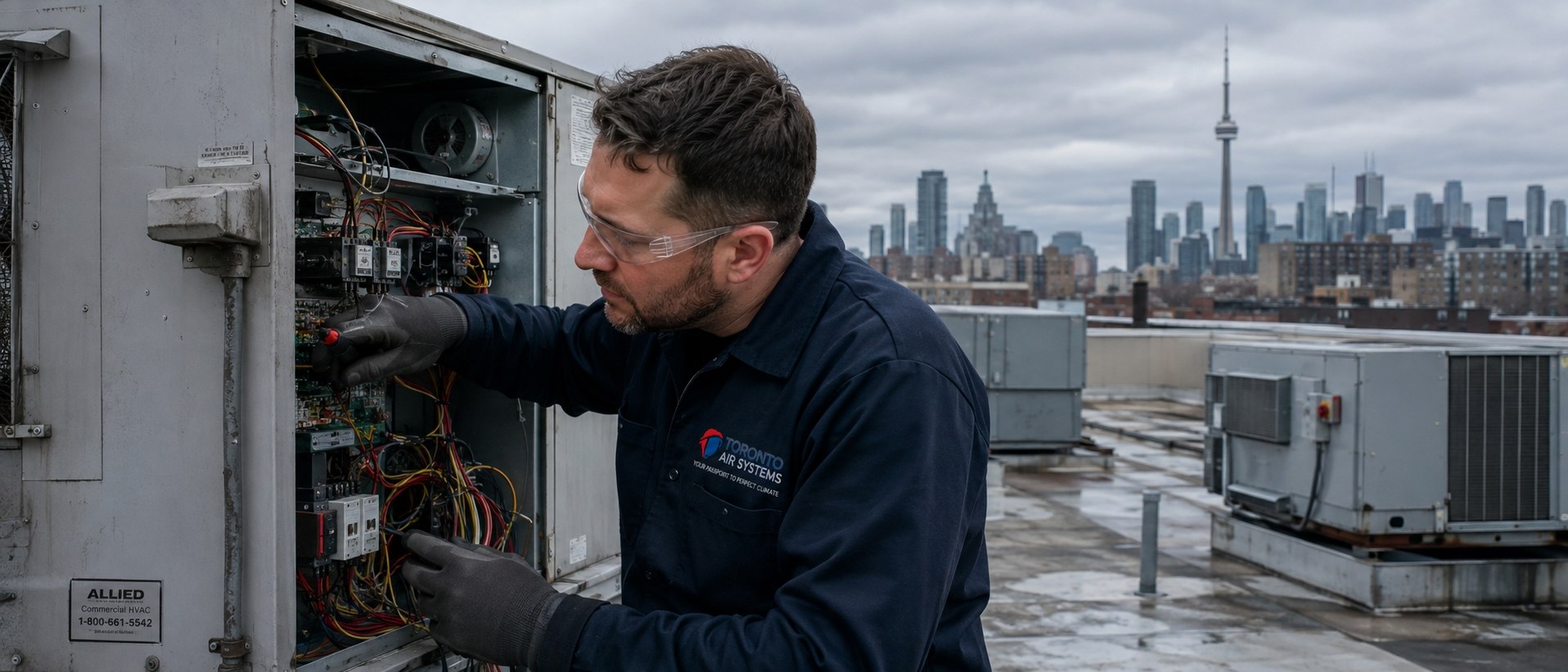
Site survey & heat specification
We measure the space, the air loss and the occupancy pattern, then specify equipment and a zone layout against what we found — not a per-square-foot rule of thumb.
Request a consultation →
Radiant tube heater systems
Overhead radiant for warehouses, bays, workshops and garages, laid out to warm the floor and the people on it.
Tube heaters →
Patio & outdoor heating
Infrared heating for restaurant terraces, semi-enclosed dining and hospitality spaces, zoned by seating area.
Patio heaters →
Rooftop units & make-up air
Packaged rooftop heating and cooling, plus the tempered make-up air that a commercial kitchen needs to stop fighting its own extraction.
Rooftop HVAC →
Commercial boilers & hydronic
Boiler replacement and hydronic heating for mixed-use buildings, including in-floor systems.
Commercial boilers →
Planned maintenance contracts
Scheduled servicing around your operating hours, with documented visits and priority response for property managers and multi-site operators.
Request a consultation →

Survey first

The room decides the equipment, not the catalogue

Ceiling height, door traffic and extraction are what make a warehouse and a dining room need completely different answers. We measure before we specify.

Request a site survey
Design first
Then equipment
The cheapest heat in a commercial space is the heat you never had to produce. Zoning empty areas off, aiming heat where people actually are, and closing the gap between extraction and make-up air will do more for a winter gas bill than any single specification sheet. Efficiency is mostly design and operation — not one number on a box.
Why Toronto Air Systems

Why GTA operators use us for commercial heat

Local crews, licensed workmanship, and recommendations built around how Toronto buildings actually heat and cool — not generic scripts.

We schedule around trading hours
Surveys, installs and servicing planned for closed periods and quiet shifts. Buildings that cannot simply close for the day are the normal case here, not the exception.
TSSA-licensed on every gas connection
Every gas connection is made by a TSSA-licensed technician. No uncertified subcontractors on commercial gas work.
We specify from a survey, not a catalogue
Ceiling height, door traffic, extraction and occupancy decide the equipment. That is why the recommendation for a warehouse and a dining room are rarely the same product.
One team, survey to commissioning
The people who surveyed the space are the people who commission it, so nothing is lost between the quote and the switch-on.
How it works

How a commercial project runs

From first call to commissioned equipment, you always know the next step, the timeline, and what is included.

01
Site survey
We walk the space, measure it, and ask how it is actually used through the day and the week.
02
Specification & zone layout
Equipment, positions and zones proposed against the survey, with the reasoning written down.
03
Written quote
Scope, equipment, labour, timeline and warranty in writing before anything is ordered.
04
Installation
Licensed install scheduled around your operating hours, with gas, venting and electrical to code.
05
Commissioning & handover
Controls set up, zones demonstrated to your team, and a maintenance schedule agreed.
Brands we work with

Commercial heating brands we specify

We are not tied to one manufacturer, so the specification follows the space rather than a quota.

Where we work

Commercial heating across the GTA

From our North York shop we cover the Greater Toronto Area for commercial heating work.

Toronto
All neighbourhoods & districts
North York
Our home base
Mississauga
West GTA residential & commercial
Brampton
Full HVAC coverage
Vaughan
Including Woodbridge & Concord
Markham
East GTA homes & businesses
Richmond Hill
Residential & mixed-use
Scarborough
East Toronto
Etobicoke
West Toronto
Oakville
Halton Region
Pickering & Ajax
Durham Region
Whitby & Oshawa
East GTA
FAQ

Commercial heating FAQ — Toronto & GTA

Usually both, doing different jobs. Kitchen extraction removes a large volume of air that has to be replaced, so tempered make-up air handles the kitchen side. The dining room is a comfort question — and where there is a patio or a door opening onto the street, radiant heat aimed at the seating works better than trying to warm air that keeps leaving.
You can extend the usable season considerably, and shoulder seasons especially. What radiant heat cannot do is hold an open patio at indoor temperature in deep winter — nothing can, because there is no envelope. The honest goal is comfortable seating for guests in coats, in the parts of the patio you choose to heat.
There is no single figure, and any supplier quoting one without seeing the space is guessing. Coverage depends on the unit's output, the height and angle it is installed at, the type of heater, how much air movement there is, and the shape of the space. We design zones from those five factors rather than selling a heater count.
Yes. Most commercial work here is scheduled around trading — early mornings, closed days, or overnight where the site allows. That is agreed at quoting stage rather than negotiated on the day.
Yes, provided it is safe and serviceable. We will tell you plainly if something has been installed in a way that cannot be signed off, and what it would take to correct.
Yes — scheduled servicing with documented visits and priority response, which is the usual arrangement for property managers and multi-site operators.
Cost depends on equipment capacity, brand, duct or piping complexity, electrical/gas upgrades, and whether you repair or replace. We provide written quotes after a site assessment so you can compare options fairly. Call 647 953-4252 for a visit.
Yes. We are based in North York at 132 Cartwright Ave and regularly serve Toronto, Mississauga, Vaughan, Markham, Scarborough, Etobicoke, Brampton, and nearby communities.
Yes. Gas and refrigeration work is performed by TSSA-licensed technicians. We follow Ontario code practice for venting, refrigerant handling, electrical disconnects, and condensate management.
Many like-for-like replacements finish in one day; complex duct, line-set, or commercial projects may take longer. Your written quote includes the expected schedule and any crane or access notes.

Talk to us about your space

Tell us what the room does and how it is used, and we will tell you what it needs. Survey first, written quote second.